

I began my portrait painting training at the Art Student's League in New York. The instructors were acclaimed. The studios cramped and overcrowded. Promises were made. Few were kept. Progress was painfully minimal.
My supposed training was tinkering. Fix that, correct this, make it more luminous!? No coherent rationale was offered.
In fairness, my instructors were present only twice a week and faced with upwards of sixty students. All of them requiring attention within the allotted three hours of class time.
Swept aside in an obscure studio was an ill-attended class studiously drawing rectangles and shapes and checking them afterward to assess their accuracy. Being young and judgmental I dismissed this class out-of-hand. How boring and stultifying. I returned to my cramped class to tinker.
A few weeks later I again wandered into that class of outliers and my jaw hit the floor!
They had all advanced far, far beyond any of my then-fellow students, some of whom had been attending that cramped class for years.
I didn't know it then, but that small class was being successfully trained according to the teachings of John Singer Sargent and William Merritt Chase. It is a curriculum that works.
Suffice it say that I couldn't join this class fast enough! I was tired of spinning my wheels and getting nowhere.
Your portrait painting specialty channel
A step by step structured pathway from beginner to professional
Portrait painting refracts truth; it is the felt conveyance of individuality; the concreteness of the regard.
It goes without saying that the portrait is the most challenging of all the realist genres of painting.
Drawing is the primal means of visual communication and expression.
The practice of portrait painting requires a specific skill-set that can only be acquired with a layered approach of shape recognition, visual awareness and knowledge.
Learn to see shape. That is the essence of the likeness and character of your sitter
First, and foremost, is learning how to block-in the specific BIG shape with a laser precision. Within the big shape resides the likeness and expressive/emotional tenent. I call this striking the arabesque, it informs line, shape and gesture. Terminology implies intent.
Once this skill is acquired, this first hurdle cleared, the pathway to mastering portrait painting is clarified and the journey made more sure.
Portrait Painter TV begins your structured pathway at absolute ground zero and layer-by-layer you will acquire the skill-sets and syntax of solid portrait painting.
........
Try Portrait Painter TV for FREE for two weeks
After that your comprehensive portrait training is only $17/month. You pay monthly. There is no yearly plan so you can pause or cancel whenever you need to. If you can only paint once a week it is still less than that coffee steaming on your taboret.
I'll notify you two days before your trial ends. Allowing you time to make an informed decision as to whether or not I am the teacher for you.
The Workshops are also available as individual on-demand videos.
I came to know Michael Britton a few decades ago as a student. I benefited greatly from his extensive background and aesthetic poetry in terms of my classical training in art and specifically portraiture.
The things I learned through Michael have stood me well over the years. I can't tell you how excited I was when I heard about this new iteration that he was offering.
Like all good things that have value, we need to keep our hand in it and practice over time. Michael brings extensive knowledge and a well-honed pedagogy with regard to art and the creation of it. I might add that he has a beautiful and sensitive body of artwork that he has created over the years and continues to keep his hand in, as well. This means something. He does not just talk the talk.
Michael is so generous with his knowledge to his students. He is a funny guy as well, which I really appreciate.
I would highly recommend planting your flag firmly in the ground in terms of your artistic training with Michael. The man knows what he is speaking of. I feel very grateful that he's created this offering for us. It's hard to believe this caliber and quality of instruction is being offered for so little.
As I remember Michael saying one time, that "we stand on the shoulders of giants" referring in our artistic endeavours and education, which lasts a lifetime.
What an opportunity to to do just that with your training with Michael in The Portrait Painter TV workshops.
Linden Morris Delrio, April 2026
xxxxxxxx
xxxxxxxx
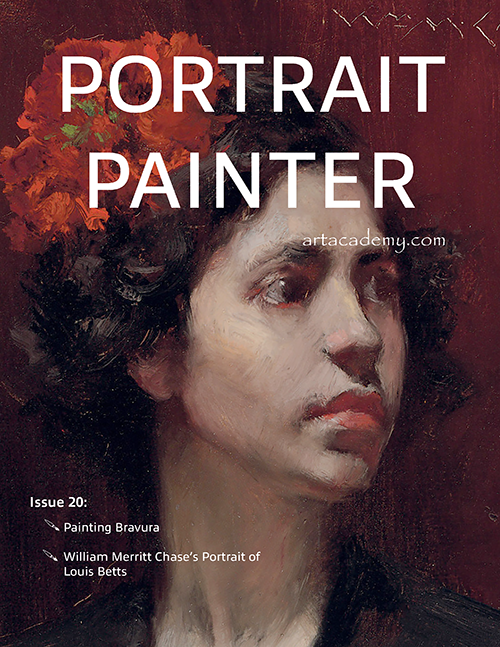
For the serious portrait painter ...
Featuring the technical nuts & bolts of painting portraits in oil. Whether you are a beginner unsure of how to begin a portrait or a seasoned painter looking to push your painting to the next level the needs of the serious painter are addressed.
And PORTRAIT PAINTER is free!
... you don't need to subscribe, but why risk missing an issue?
'Oh how I look forward to your monthly issues! This one is definitely not for the faint of heart or to leisurely view with morning tea. I will come back to it though and devour every line and image! Thank you for your knowledge and gift of writing. I so enjoy it!'
Nancy
xxxxxxxx
........
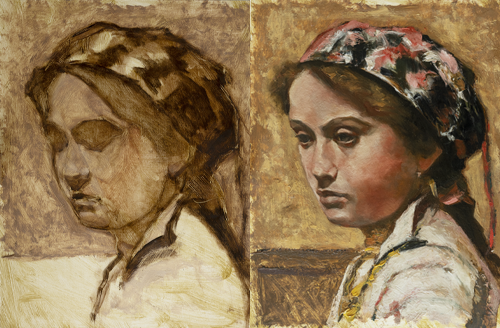
Corot's The Greek Girl is a painterly process of distilling the facial forms through a wall of complexity.
Drawing with a loaded brush the arabesque is succinctly struck and the planar forms blocked-in. From there the painting proceeds utilizing a reductive additive/substractive means of applying paint with a sculptural sensibility.
Get the video-on-demand workshop! It's on sale!
Jean-Baptiste-Camille Corot The Greek Girl, Portrait of Emily Dobigny, 1870
Few artists have managed a one-two punch upon the trajectory of art. First, Corot's landscapes paved the way to Impressionism; second, his figurative paintings had an immense influence on 20th Century art.
Corot's figural works have a sculptural quality. It is as if Corot carved the forms out of stone; they are still, permanent, neither wooden nor stiff. What is seen and immediately felt is the abstract structural surface (the patina) of the paint. Oil paint possesses a wondrous materiality that no other medium even comes close to matching.
The Greek Girl introduces you to the plastic element of painting with a sculptural sensibility.
29 lessons. 11 hours, 30 minutes
Video On-Demand :
Access anytime anywhere. No expiration date!
ON SALE! Only $37 for a limited time only. Regularly $77. Save $40!
I really resonate with your style of teaching. It reminds me of how we were taught in our foundations drawing class at the Cleveland Institute of Art back in the mid to late 80’s.
The lessons you present are great because they are about knowledge and observation, which is what transcends mediums. Watercolor is tough LOL! And I am glad to see the medium specific promotions, always nuggets of gold in your work and presentations!
Steve S., June 2026
xxxxxxxx

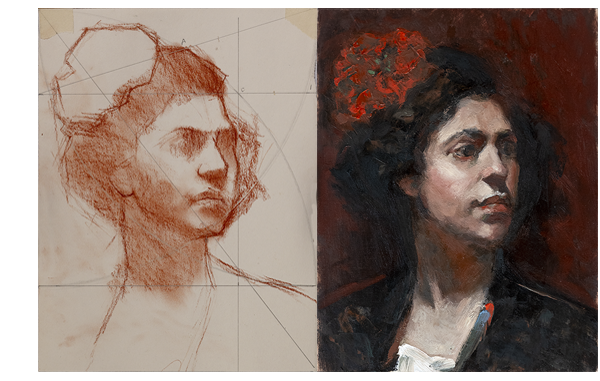
Copying William Merritt Chase's The Spanish Woman, 1879
Bravura (loose and expressive) painting is wholly incumbent upon an architecture of structural, planar forms that is built up with a sculptural sensibility. A successful bravura portrait should look effortless. As if it was nothing; as natural as breathing. But that is hardly the case.
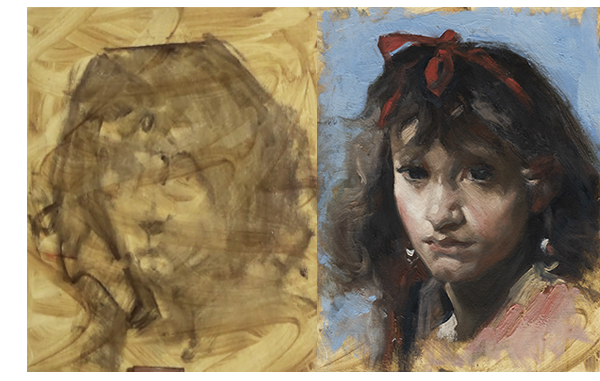
Copying John Singer Sargent's Carmela Bertagna, 1879 from the initial strike & massing to bravura finish.
Following the block-in and massing the half-tones are served up in the abstract. These are Sargent's words and his teaching method.