

The three stages of copying John Singer Sargent's Portrait of Jordan Lee, 1881
Left: Striking the arabesque (block-in) with an economy of means on a half-primed panel.
Center: Serving up the half-tones in the abstract and defining the planar structures.
Right: Painting with a sculptural sensibility. Each brushstroke is applied with a sympathetic concordance to the underlying anatomical form with a felt sensitivity to the recursive fractal constructions of the abstract structural surface. This is the essence of bravura painting.

Embarking upon the journey of learning to paint the realist portrait the beginning artist is presented with two divergent paths of study.
The more common path in today's academies is the academic or illustrative predicated on the curriculum of Jean Léon Gérôme and his apprentice Charles Bargue.
It is a sound curriculum. Do the work and a solid skill-set of drawing technique will be acquired. However, the Gérôme/Bargue pedagogy is suffused with a neo-classical aesthetic, that was the timbre of the times, and is hard to shake.
........
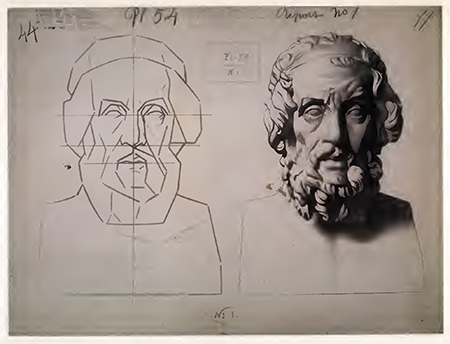
My opinion is that Part 1: Drawing After Casts of the Bargue plates is the most useful. It is here that you learn sight-sizing, shape recognition and an awareness of the importance of triangles which are indispensible in charting the interior forms of facial expression.
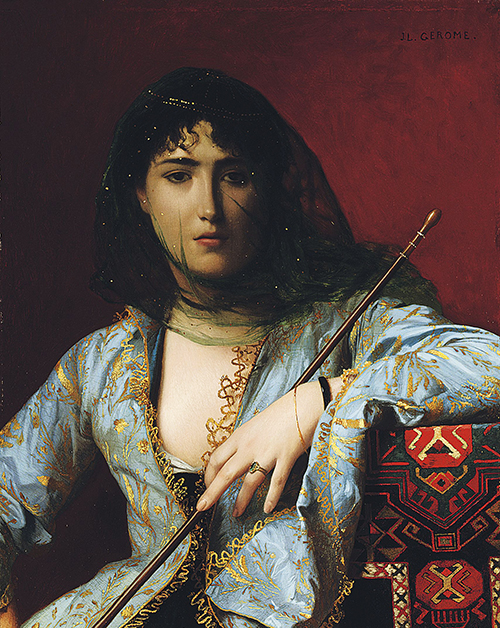
In the latter half of the 19th Century Gérôme was celebrated as France's greatest painter. His classes were consistently sold out. It was for Gérôme's struggling students that Charles Bargue developed his drawing course, Cours de Dessin, in response to a growing anxiety in France of the poor state of drawing skills in young artists.
Part II: Copying Master Drawings is the weakest of the Bargue course. It's intent was to impart in the soul of the students a feeling and taste for the beautiful, through familiarizing them with creations of a pure and noble style as well as with heathy and vigorous transcription of nature. In other words le bon gout, good taste. Mid-19th Century good taste that was soon to be disassembled by the likes of Manet, Degas, et al.
The third part of the Barge course focuses exclusively on the male nude presented with a veneer of neoplatonism. It is useful, to a limited extent, for learning how to block the figure.
The other pathway is the plastic (giving form to), painting with a sculptural sensibility. This is the teaching of Corot, Carolus Duran (Sargent's mentor) and the Munich School whose alumnus included William Merritt Chase and Frank Duveneck.

The Philadelphian, Thomas Eakins studied under Gérôme at the Ecole des Beaux Arts from 1866 to 1869. In many ways Eakins surpassed Gérôme. Although his incisive insights into his sitters' psyche did not win him many commissions, he was finally bestowed with the recognition he deserved in the early 1930's. Almost two decades after his death in 1916.
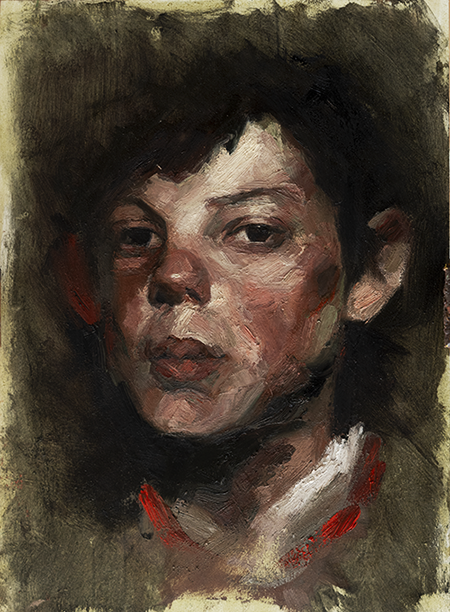
Frank Duveneck's Whistling Boy, 1872, Cincinnati Art Museum, is arguably the finest painted head in the whole of American art. It is genius fa presto!
Duveneck, three years Eakin's junior, studied at the Royal Academy of Munich (the Munich School) whose pedagogy is summed up as paint the painting, not just the subject, an approach that was diametrically opposite to Gérôme's studious academic curriculum that, frankly, was lost wandering the ruins of Athens.
The path you choose strongly informs your aesthetic. The resulting anguished ambiguity of which path to pursue is understandable.
Acquiring a solid technical skill-set is paramount. The caveat, however, is at what point does one become an academic technician at the expense of their expressive voice. For me this was a decades-long struggle.
Best to embark upon your training as a journey of discovery. Take what you need from both pathways. A balanced trifecta of technique, expression and construct (the language of painting acquired by copying) is the surest path forward.
........
I did some watercolour workshops with Michael Britton many years ago and when I saw his offering for master copy portraits in oil, I signed up. Michael is a rarity. He teaches a classical fine art approach and his feedback is thorough, and constructive. I look at portraits differently now. It was an excellent on-line learning experience.
Ceci Lam, Canada
April 2026

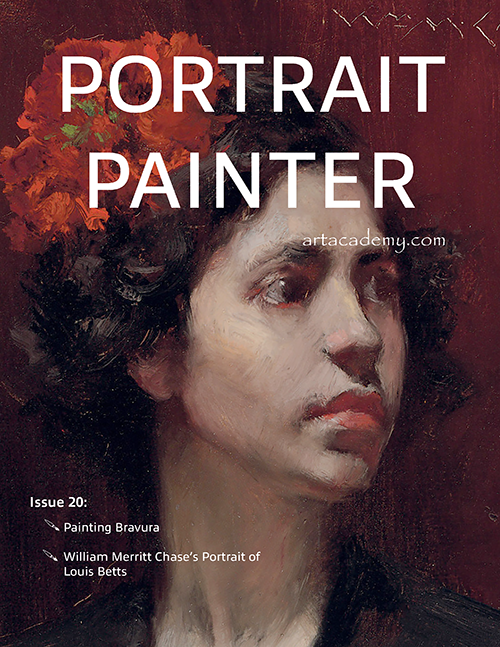
For the serious portrait painter ...
Featuring the technical nuts & bolts of painting portraits in oil. Whether you are a beginner unsure of how to begin a portrait or a seasoned painter looking to push your painting to the next level the needs of the serious painter are addressed.
And PORTRAIT PAINTER is free!
... you don't need to subscribe, but why risk missing an issue?
'Oh how I look forward to your monthly issues! This one is definitely not for the faint of heart or to leisurely view with morning tea. I will come back to it though and devour every line and image! Thank you for your knowledge and gift of writing. I so enjoy it!'
Nancy, March 2026